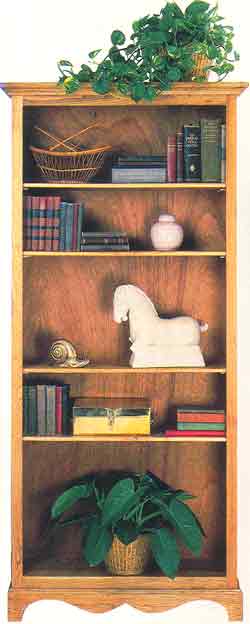
 Simple bookcases
are easy to build. A couple of sides, some shelves and a back…usually Simple bookcases
are easy to build. A couple of sides, some shelves and a back…usually
held together with some glue and a few nails. However, add just a bit
of extra effort and you can dress-up that simple carcase with some accents
that are sure to fit in with virtually any room décor. And, when
you’ve finished, you’ll have more than a simple bookcase.
You’ll have a top-quality piece of furniture that’s sure to
endure for generations.
A note about style and materials
As you can see from the photo, our example began with
a simple, box-style carcase, then added bead-and-cove top and base moldings
to give it a colonial or Early American look.
For a more contemporary look, make a box-style base with a straight-edged
front (J) and sides (K)
and a flush-edged top. For an oriental look, form 45-degree chamfered
edges on the carcase, base, top and shelf edges. The design is so simple,
that making changes for differing decors is an easy matter.
It’s also important to note that we built our bookcase carcase (except
for the back, of course)from solid red oak, although the sides, top and
bottom could just as easily be built from 3/4" solid-core, veneered
plywood. So, let’s get started.
1: Stock preparation. Cut the sides (A),
top (B) and bottom (C)
to width. Note that all three pieces are the same 11-1/4” width.
2: Build the Case.
Start by cutting the two sides (A), Top
(B) and Bottom (C)
to length. Next, use your Dado
Set to cut the 1/4" deep by 3/8” wide rabbets in the back
edges of these sides. These rabbets will house the back for the assembled
carcase.
Next, cut the 3/4" wide by 3/8” deep dadoes in the sides to
accept the Top (B) and Bottom (C).
Note that the Bookcase has adjustable Shelves that are supported by a
“hole-and-peg” system using 3/8” dia. by 1-1/4”
long dowels. These dowel holes must all be positioned in precisely the
same locations for the shelves to rest flat on their support pegs (dowels)
without wobbling.
Continue...
|
 The Adjustable Shelf Bookcase